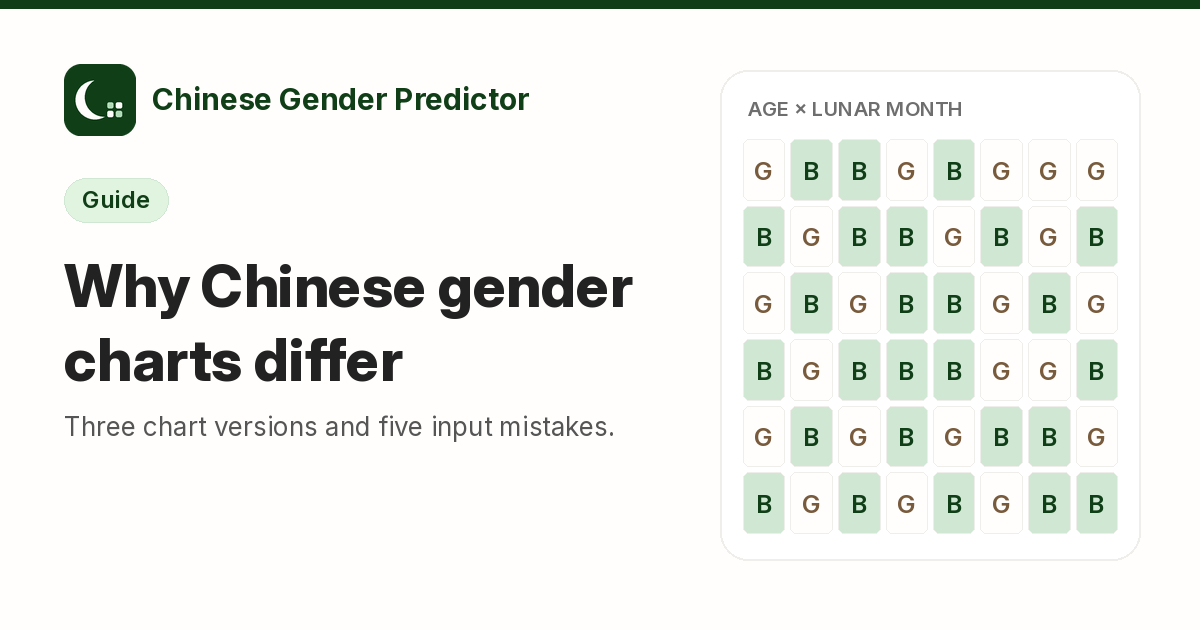
Enter the same dates on three websites and you may get Boy, Girl, Boy. There are two separate reasons: the charts themselves differ, and the inputs are calculated differently.
1. There is more than one chart
The chart has 28 rows (lunar age 18–45) × 12 columns (lunar months) = 336 cells. We transcribed several widely used published copies and compared them cell by cell:
| Compared with our chart | Cells that differ |
|---|---|
| Prokerala | 0 of 336 |
| chinesecalendar.in | 0 of 336 |
| chinesegendercalendar.org | 0 of 336 |
| chinese-lunar-calendar.com | 80 of 336 |
| R for Rabbit tool data / The Bump chart image (these two match each other) | 144 of 336 |
So at least three distinct versions circulate. We could not find a primary source proving any one of them is "the original" Qing-dynasty chart, so we don't claim ours is. We picked the version shared by three independent copies, use it everywhere on the site, and publish every disagreeing cell on our methodology page. The full chart is also there to check by hand.
2. Inputs are calculated differently
Even with the same chart, results differ when the two inputs are worked out differently:
- Ordinary age + 1. Lunar age (虚岁) isn't simply your age plus one; it depends on whether your birthday and the conception date fall before or after Lunar New Year. It can be one or two years more than your ordinary age.
- Gregorian month as lunar month. March isn't lunar month 3. In 2027, lunar month 3 runs from April 7 to May 5.
- Lichun instead of Lunar New Year. Some tools switch the year at the solar term Lichun (around February 4). The chart tradition counts age from Lunar New Year.
- Leap months. In years with a leap month, some tools treat it as the next month or skip it. We read a leap month from the column with the same number, and mark it with a Leap tag.
- Due date instead of conception date. This shifts the month by about nine months. See how to estimate your conception date.
What we do about it
Our predictor shows the lunar dates, lunar age and chart cell it used, so you can compare with any other site and see exactly where the difference comes from. And whichever version you use, the result is for fun only.