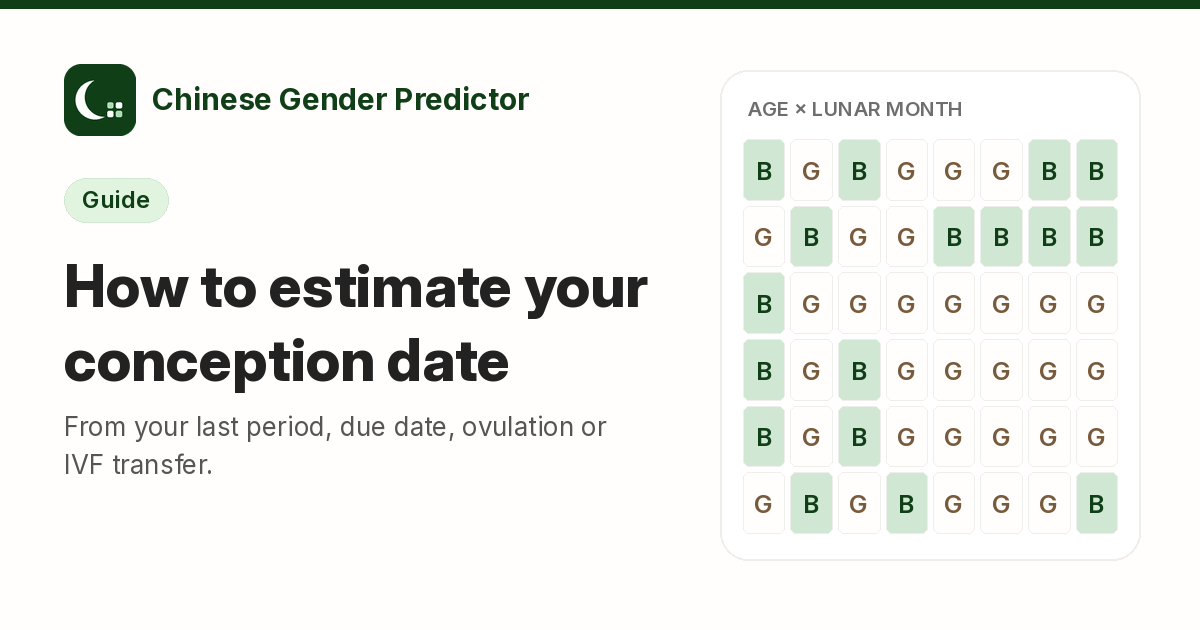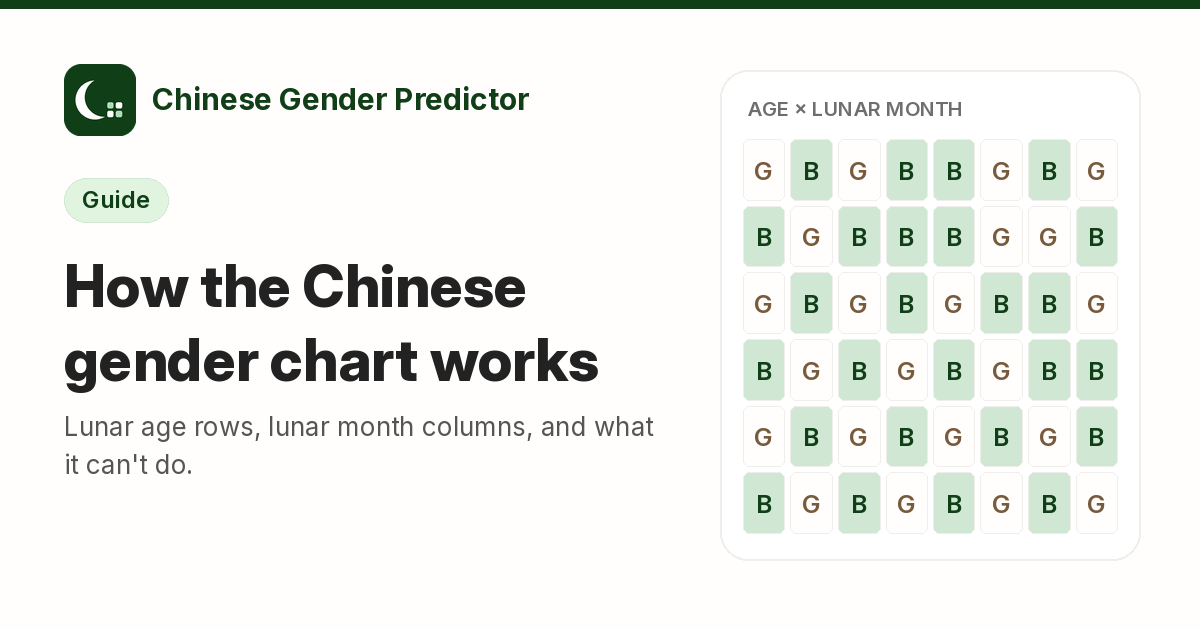
The Chinese gender chart (清宫表, often called the Chinese gender calendar) is a grid. Rows are the mother's lunar age at conception, usually 18 to 45. Columns are the lunar month of conception, 1 to 12. Each of the 336 cells holds one word: Boy or Girl.
Reading the chart in three steps
- Convert the conception date to a lunar date. The lunar month gives you the column. Lunar months start on a new moon, so they don't line up with January–December.
- Work out lunar age. Take the lunar year of conception, subtract the lunar year of the mother's birth, and add 1. Age changes at Lunar New Year.
- Read the cell where that row and column meet.
That's all. There is no extra input, no weighting and no randomness. The same two numbers always point at the same cell. You can try it with the predictor.
Why the "2026 chart" and the "2027 chart" are the same chart
Many pages advertise a chart for a particular year. The grid itself doesn't change. What changes each year is which Gregorian dates belong to each lunar month — Lunar New Year moves between January 21 and February 20. Our year calendar shows those dates for any year from 1901 to 2100.
Why different websites give different answers
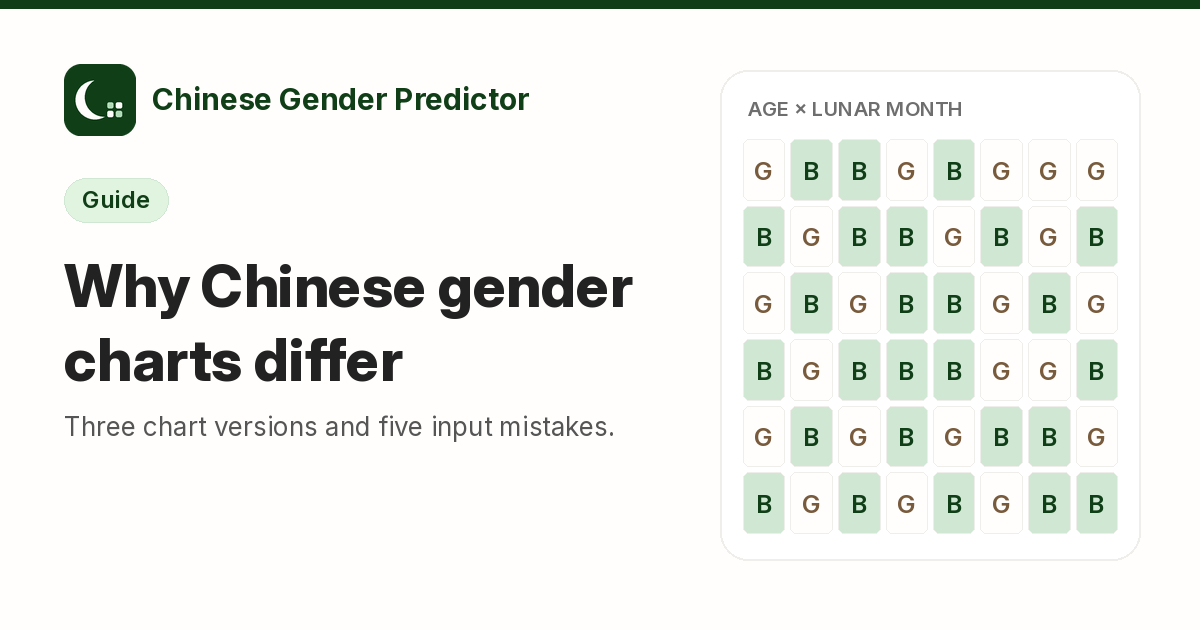
More than one version of the chart is published online. When we compared copies cell by cell, Prokerala and two other sites matched in all 336 cells, while the R for Rabbit tool data and The Bump chart image matched each other but differed in 144 cells. A Chinese-language site differed in 80 cells. No source we found proves any of these is the single "original" chart. We use one version throughout and list every cell where others differ on How it works.
Other common causes of mismatched results:
- using ordinary age + 1 instead of a real lunar-year calculation;
- using the Gregorian month number as the lunar month;
- switching the year at Lichun (around February 4) instead of Lunar New Year;
- treating leap months inconsistently.
What the evidence says
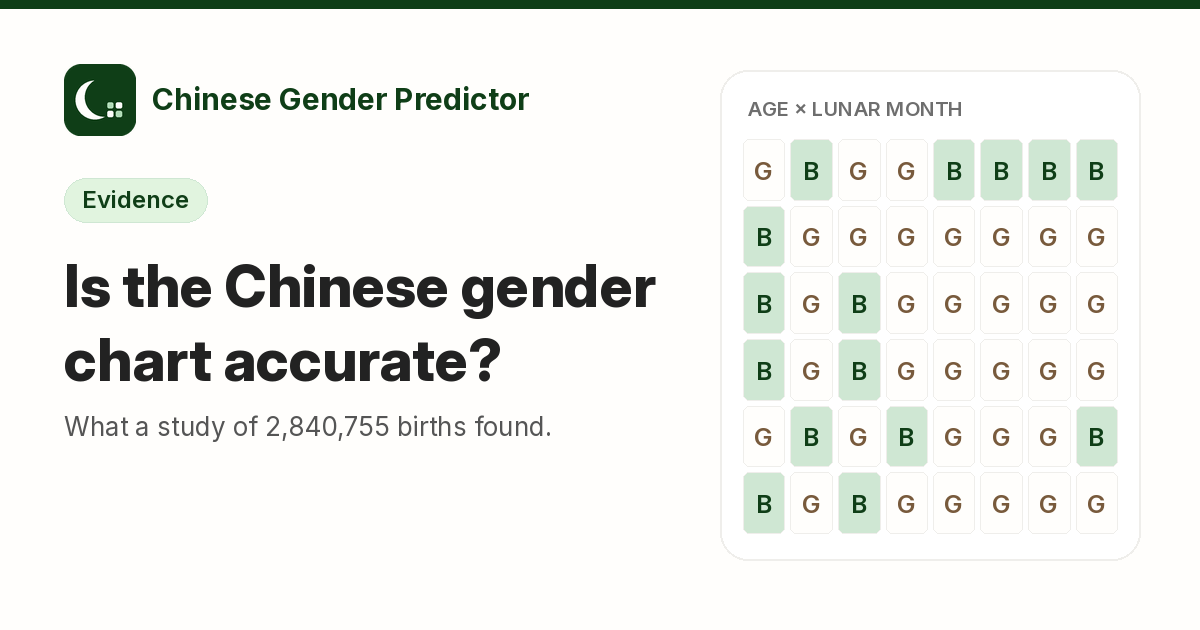
A population study published in 2010 (Villamor et al., Paediatric and Perinatal Epidemiology) applied the Chinese gender chart to 2,840,755 singleton births recorded in Sweden. Read the details in Is the Chinese gender chart accurate?.