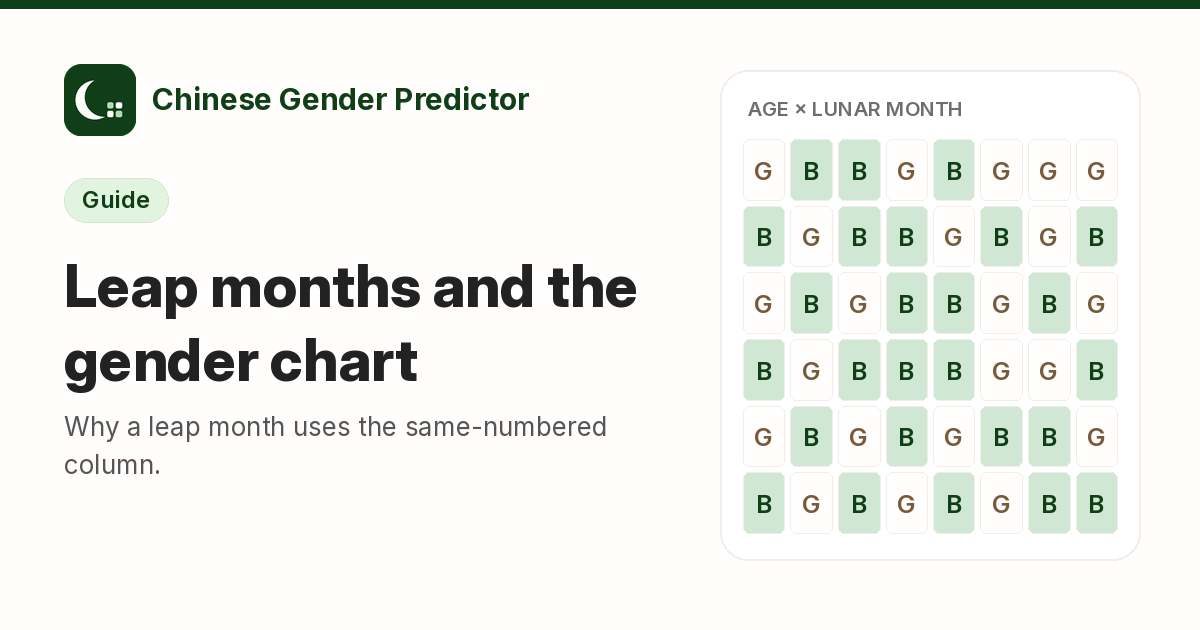
The chart has 12 columns, but some lunar years have 13 months. The extra one is a leap month (闰月).
Why leap months exist
A lunar month is about 29.5 days, so 12 of them are about 354 days — roughly 11 days short of a solar year. To keep festivals in their seasons, the Chinese calendar inserts an extra month about seven times every 19 years. The leap month repeats the number of the month before it.
The 2025 example
According to the Hong Kong Observatory table for 2025:
- June 25, 2025 starts the regular 6th lunar month;
- July 25, 2025 starts the leap 6th month;
- August 23, 2025 starts the 7th month.
How this site reads a leap month
We use one rule everywhere — in the predictor, the chart, the year calendar and print views:
This tool maps a leap month to the same numbered lunar month.
So a conception on July 25, 2025 reads column 6, and the result shows a Leap tag so you can see it happened. We don't add a 13th column, and we don't shift leap months to the next month.
This is a product convention, not a claim about an ancient rule. Other tools may treat leap months differently, which is one reason results can differ between sites.
Seeing leap months yourself
Open the year calendar and pick 2025, 2023 (leap 2nd month) or 2028 (leap 5th month). Leap months are marked. The How it works page explains the full method.