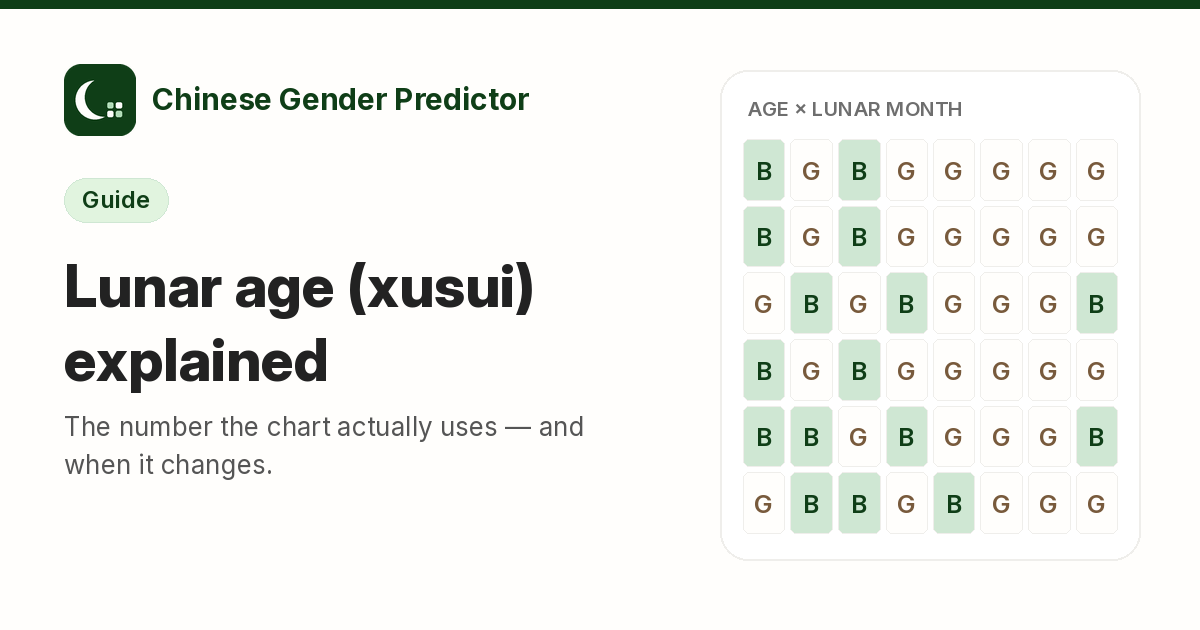
The Chinese gender chart's rows are not your ordinary age. They use lunar age (虚岁, xūsuì), a traditional way of counting age.
The rule
- You are 1 at birth.
- You gain a year at every Lunar New Year (正月初一), not on your birthday.
So the age to use at conception is:
lunar age = lunar year of conception − lunar year of birth + 1Both years must be lunar years. A date in January or early February often belongs to the previous lunar year.
A worked example
Take a mother born in lunar year 1994 (for example, June 1, 1994).
| Conception date | Lunar date | Lunar age |
|---|---|---|
| February 16, 2026 | lunar 2025, 12th month | 2025 − 1994 + 1 = 32 |
| February 17, 2026 | lunar 2026, 1st month, day 1 | 2026 − 1994 + 1 = 33 |
One day apart, two different rows — because Lunar New Year 2026 fell on February 17 (per the Hong Kong Observatory conversion table).
Three common mistakes
- "Just add 1 to my age." Ordinary age + 1 is right only part of the year. Lunar age can be one or two years more than your ordinary age.
- Using Gregorian years. Subtracting 1994 from 2026 gives the wrong answer for anyone conceiving before Lunar New Year, or born in January/early February.
- Switching at Lichun. Lichun (立春, "start of spring") is a solar term around February 4. Some astrology systems change year there; the lunar-age count we use changes at Lunar New Year. In 2026 these are 13 days apart.
What if your lunar age is under 18 or over 45?
The chart we use has no row for it. A careful tool should say so instead of quietly using the nearest row. Ours does.
Try your own dates in the predictor, and open Show calculation steps to see each step.