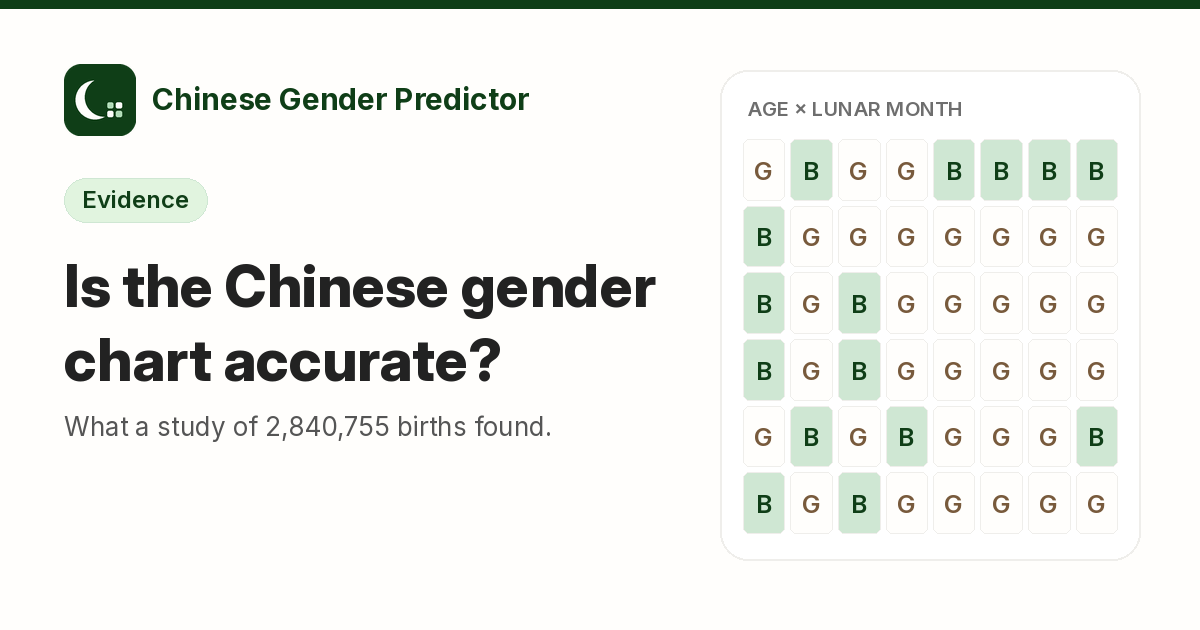
Some websites claim the Chinese gender chart is "up to 93% accurate". The best evidence we have says it performs about as well as a coin toss. Here's where that conclusion comes from.
The study
In 2010, epidemiologist Eduardo Villamor (University of Michigan) and colleagues at the Karolinska Institutet published Accuracy of the Chinese lunar calendar method to predict a baby's sex: a population-based study in Paediatric and Perinatal Epidemiology (vol. 24, issue 4, pages 398–400).
They used the Swedish Medical Birth Register:
- 3,400,212 births between 1973 and 2006 were the starting point.
- Records without a last-menstrual-period date, non-Swedish mothers (to keep a single time zone), multiple births and mothers outside lunar age 18–45 were removed.
- That left 2,840,755 singleton births.
For each birth they estimated the mother's lunar age and lunar month of conception, looked up the chart, and compared its prediction with the baby's actual sex.
The result
Agreement was measured with Cohen's kappa, where 0 means "no better than chance" and 1 means perfect agreement.
| Test | Kappa | 95% CI |
|---|---|---|
| Whole sample (2,840,755 births) | 0.0002 | −0.0009 to 0.0014 |
| 1,000-birth subset using a website's own lunar-date algorithm | −0.02 | −0.08 to 0.04 |
Accuracy did not change with year of conception, maternal age, education, BMI or number of previous children. Even deliberately "misusing" the chart — skipping the lunar conversion — didn't change anything. The authors' conclusion: the method is no better than tossing a coin, and they advised against painting the nursery based on it.
Why the chart feels accurate
- Any guess is right about half the time. With two outcomes, a coin is "accurate" for roughly 1 in 2 families, and those are the stories people share.
- Many versions exist. If one site says Boy and another says Girl, one of them will look right afterwards. We found published copies that disagree in up to 144 of 336 cells (see why charts differ).
- Inputs get adjusted. If the first answer is "wrong", it's tempting to recompute with ordinary age + 1 or a different month until it matches.
So why use it at all?
As folklore it's fun: it's a centuries-old tradition, it sparks conversation at a baby shower, and it's a good excuse to learn how the Chinese lunar calendar works. Our predictor does the date conversion carefully and shows every step so you always know exactly which cell of the Chinese gender calendar you are reading.
For a real answer, talk to your clinician: ultrasound and prenatal screening tests are how fetal sex is actually determined.
Source: Villamor E, Dekker L, Svensson T, Cnattingius S. Paediatr Perinat Epidemiol. 2010;24(4):398–400. doi:10.1111/j.1365-3016.2010.01129.x